

Want to know how to get a scholarship in Italy? The answer is simple but often ignored: start early. Most scholarship deadlines fall close to admission and visa deadlines, and the documents they need, especially family income and property papers, take weeks to translate and legalise. Students from Pakistan, India and Bangladesh who start in the autumn, about a year before their intake, have a clear advantage.
This guide explains the main types of scholarships in Italy, who can get them, which documents to prepare now, and a month-by-month plan for the 2027–28 intake.
Key takeaways
- The DSU regional scholarship is the biggest source of funding for international students. It is need-based and can include a cash grant, free meals, housing and a tuition waiver.
- University merit scholarships reward strong grades and test scores, and some need a separate application.
- Your family income documents take the longest to prepare, so start them before you even apply.
- Apply to DSU in the same region as your university, and follow the official call exactly.
Types of scholarships in Italy
| Scholarship | Based on | What it can cover | When to apply |
|---|---|---|---|
| DSU regional scholarship | Family income and assets (ISEE parificato) | Cash grant, meals, housing, tuition waiver | Summer, after admission |
| University merit scholarship | Grades, test scores or admission ranking | Tuition waiver and/or cash award | With or soon after admission |
| Italian government scholarship | Merit and nationality (varies by call) | Monthly allowance, tuition support | Usually spring |
| Erasmus Mundus joint master’s | Merit, highly competitive | Full scholarship: tuition, travel, living costs | Usually winter before intake |
| Tuition fee reductions | Family income or country of origin | Lower tuition fees | At enrolment |
1. DSU regional scholarships (need-based)
DSU (Diritto allo Studio Universitario) is the largest source of funding for international students in Italy. Regional agencies award it based on family income and assets, measured through the ISEE parificato. It can include a tuition fee waiver, a yearly cash grant, free or reduced meals and housing in a student residence. Read our complete DSU scholarship guide for eligibility, amounts and deadlines.
2. University merit scholarships
Many universities offer their own scholarships for strong international applicants, based on grades, test scores or the admission ranking. Some are awarded automatically with admission, while others need a separate application with its own deadline. Check the scholarship page of every university on your shortlist, and note the deadline in your tracker.
3. Italian government scholarships
The Italian Ministry of Foreign Affairs runs scholarship programmes for foreign students, published on its Study in Italy portal. Calls, eligible countries and deadlines change each year, so check the current call early and prepare your documents in advance.
4. Erasmus Mundus and EU-funded master’s
Joint master’s programmes funded by the European Union often include Italian universities and offer full scholarships. They are very competitive, and deadlines are often in the winter before the intake, so these are the first applications you should prepare.
5. Tuition fee reductions
Even without a full scholarship, public universities usually set tuition according to family income, and some offer reductions for international students. This is why preparing your income documents matters, even if you do not receive DSU.
Who can get a scholarship in Italy?
International students from Pakistan, India and Bangladesh can apply for all of the scholarships above, as long as they meet each call’s rules. In practice, you improve your chances by:
- Having a clear academic profile with good grades and a strong CV
- Applying to programmes that match your background, so you are admitted early
- Preparing complete, correctly legalised family documents for DSU
- Applying to more than one type of scholarship where combining is allowed
Documents to prepare early
Start collecting these now, as many need official translation and legalisation:
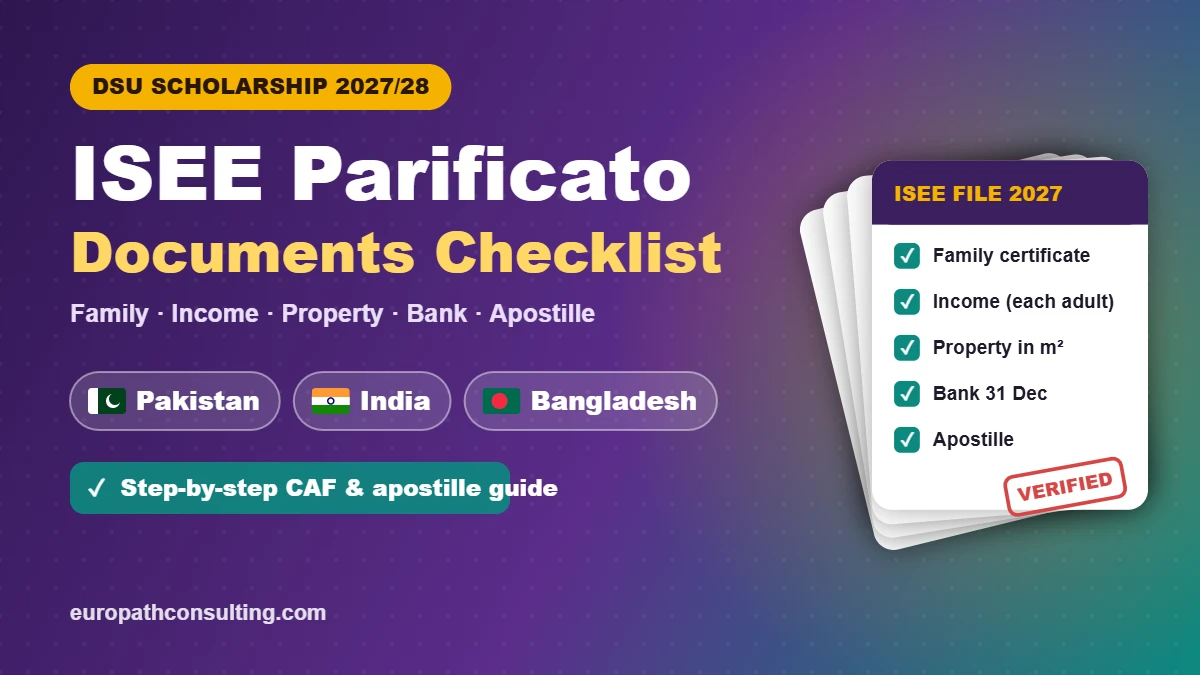
- Family income documents for the relevant year (salary certificates, tax returns or income statements)
- Property and asset documents for the family, including property in your home country
- Family composition certificate (for example, a family registration certificate)
- Bank statements, where required
- Academic transcripts and certificates
- English test results and a strong CV
Rules on which documents are needed, and how they must be translated and legalised, differ by region and year, so always follow the official call for your region.
Scholarship timeline for the 2027–28 intake
- October–December 2026: shortlist universities, check their merit scholarships and government calls, and start collecting family documents.
- January–March 2027: translate and legalise income and property documents, and apply for merit and EU-funded scholarships with early deadlines.
- Spring–summer 2027: receive admission, complete Universitaly pre-enrolment, and apply for DSU when your region’s call opens.
- Autumn 2027: confirm your DSU ranking, enrol, and follow the agency’s instructions to receive payments.
Keep this timeline next to our Italian university deadlines for 2027–28, because admission and scholarship dates overlap.
How to track every scholarship deadline
- Make one spreadsheet with each scholarship, its official link, deadline, required documents and status.
- Note who runs it: the university, the regional DSU agency or the ministry.
- Set reminders two weeks and two days before each deadline.
- Save a PDF of every submitted form and payment receipt.
- Check official pages again before you submit, as calls can change.
Common scholarship mistakes to avoid
- Starting family income documents after admission, when there is no time left to legalise them
- Leaving out family property or income, which can lead to losing the scholarship later
- Applying to DSU in the wrong region (it must match your university’s region)
- Missing a merit scholarship that needs a separate application
- Spending your budget on application fees instead of documents. Shortlisting some Italian universities with no application fee helps.
Frequently asked questions
Can international students get a scholarship in Italy?
Yes. International students can apply for DSU regional scholarships, university merit scholarships and Italian government scholarships, depending on each call’s rules.
When should I start preparing for scholarships in Italy?
Ideally in the autumn, about a year before your intake. Family income and property documents are usually what takes longest to prepare.
Is the DSU scholarship only for low-income families?
DSU is need-based, so eligibility depends on your family’s income and assets, measured through the ISEE parificato. Many students from Pakistan, India and Bangladesh qualify.
Can I get more than one scholarship in Italy?
Sometimes. Some scholarships can be combined and others cannot. Each call explains its rules on combining funding.
Get help with your scholarship plan
Not sure which scholarships fit your profile? Check your options with our free eligibility checker, then book a free profile review. We help students from Pakistan, India and Bangladesh plan their applications, DSU documents and deadlines. See also our scholarships in Italy overview.