
The DSU scholarship in Italy is one of the most generous need-based scholarships in Europe. If your family income is modest, it can cover your tuition fees, give you up to €7,000–€8,000 a year in cash, and help with meals and student housing, whether you come from Pakistan, India or Bangladesh.
Many students miss out, though. Usually it isn’t because they aren’t eligible. It’s because they misunderstand how DSU works, or start their family income documents too late. This guide explains everything step by step, using the official 2026/27 figures, so you can plan your 2027–28 application properly.
What is the DSU scholarship?
DSU stands for Diritto allo Studio Universitario, which means “the right to university study”. It is Italy’s national system of support for students with limited financial means. It is not a single scholarship from one office. It’s a framework set by the Italian Ministry of University and Research (MUR) and run by each region.
A DSU award can include:
- A cash scholarship (borsa di studio), paid in two instalments
- Full tuition fee waiver at your public university
- Free or discounted meals at university canteens
- Student accommodation in some regions, often deducted from the scholarship
The scholarship is awarded mainly on family income and assets, not on grades. That’s why it suits international students so well. In your first year, you don’t need top marks to qualify.
Country guides: study in Italy from Pakistan · from India · from Bangladesh
DSU vs ESU, EDISU, DiSCo and ER.GO: is it the same scholarship?
Yes. This is the most common confusion we hear from students. The national rules are the same, but each region manages DSU through its own agency or through the universities, and each agency has its own name:
| Region (main cities) | Who manages DSU |
|---|---|
| Veneto (Verona, Padova, Venezia) | The universities and the regional ESU agencies |
| Toscana (Florence, Pisa, Siena) | DSU Toscana |
| Lazio (Rome) | DiSCo Lazio |
| Piemonte (Turin) | EDISU Piemonte |
| Emilia-Romagna (Bologna, Parma, Modena) | ER.GO |
| Lombardia (Milan, Pavia) | Mostly each university directly |
So if a friend says “I got EDISU in Turin” and you got “ESU in Verona”, you both have a DSU scholarship. What changes from region to region is the call for applications (bando), with its own deadlines, portal, document rules and sometimes lower income limits. Always read the bando of the region and university where you will actually study.
Deadlines and income limits differ by region. Compare all 14 calls for 2026/27, with an ISEE eligibility checker, in our DSU scholarship by region guide.
How much is the DSU scholarship in 2026/27?
For 2026/27 the Ministry raised the national base amounts by 1.4%. The amount depends on where you live while studying:
| Student category | Who it applies to | National base amount 2026/27 |
|---|---|---|
| Fuori sede (off-site) | You live in the university city and rent there; most international students | €7,171.11 / year |
| Pendolare (commuter) | You travel daily from a nearby town | €4,190.71 / year |
| In sede (local) | Your family lives in the university city | €2,890.16 / year |
Students with the lowest family income often receive more than the base amount. For example, at the University of Verona a fuori sede student with an ISEE up to €13,153.11 receives €8,246 for 2026/27. Students closer to the income limit receive a reduced amount.
Keep in mind that meals and housing are usually deducted from the scholarship. In Verona, for example, €760 is deducted for meals for fuori sede students, plus the housing cost if you get a room in a student residence.
Who is eligible? (Income, assets and merit)
1. Family income: the ISEE limit
Eligibility is measured with the ISEE (Indicatore della Situazione Economica Equivalente), which combines your family’s income and assets, adjusted for family size. Students whose families live abroad need an ISEE parificato; see our ISEE parificato documents guide for Pakistan, India and Bangladesh. For 2026/27 the national maximum limits are:
- ISEE: up to €28,339.88
- ISPE (family assets indicator): up to €61,608.48
Regions can set lower limits. In Veneto, for example, the 2026/27 limits are ISEE €26,306.25 and ISPE €43,125.94. Your region’s bando is the only figure that counts.
2. ISEE parificato for international students
Because your family income and property are outside Italy, you cannot get a normal ISEE. Instead you need an ISEE parificato. It’s calculated by an authorised tax assistance centre (CAF) in Italy, using official documents from your home country. More on the documents below.
3. Merit: easy in year one, important later
In your first year, the scholarship is awarded on economic conditions only. To keep the money, you must then pass exams. In Veneto, for example, first-year students must earn at least 20 CFU (credits) by 10 August to receive the second instalment. From the second year onwards, you need a minimum number of credits to apply again. Plan your exams from the start of the semester.
Documents for ISEE parificato (Pakistan, India & Bangladesh)
This is where most applications succeed or fail. Start collecting these documents at least 2–3 months before you travel to Italy.
For students from Pakistan and India
You normally need official documents covering your whole family unit (you, your parents and any siblings living with them), issued in your home country:
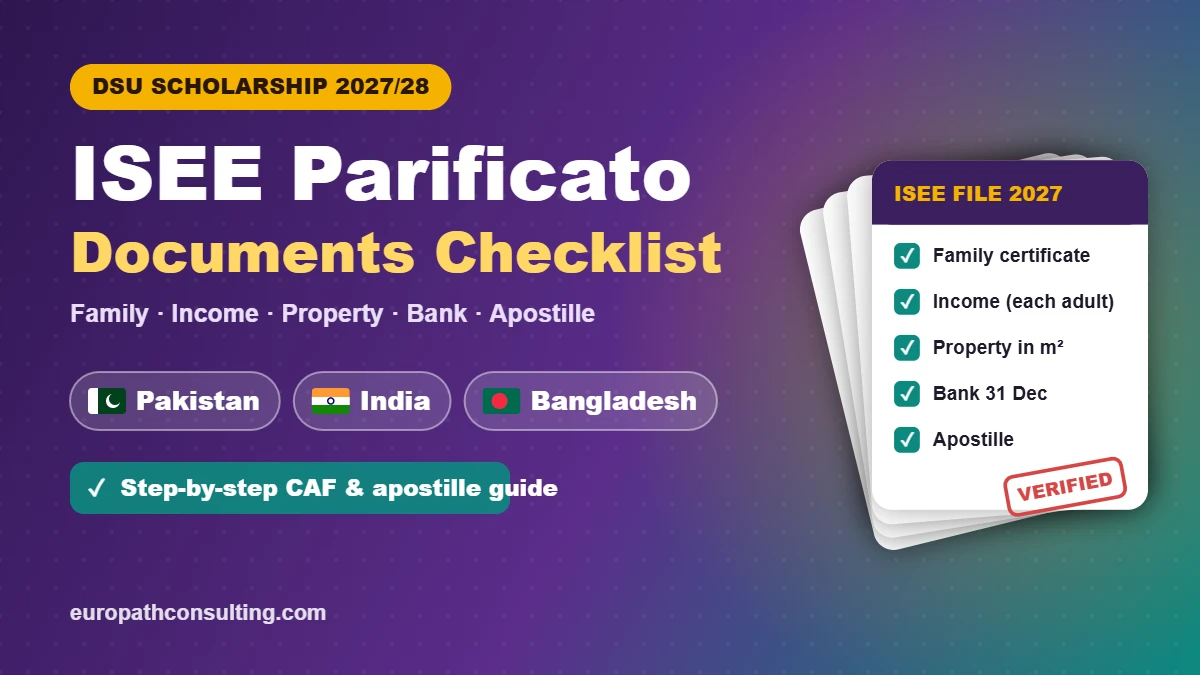
- Family composition certificate: a document listing all family members, such as the NADRA Family Registration Certificate (FRC) in Pakistan, or a government-issued family certificate or ration card in India
- Income of each family member over 18 for the reference year (two years before the academic year), such as salary certificates, tax returns or income certificates, or a certificate of no income for members who don’t work
- Property and real estate: ownership documents with the size of houses and land, or a certificate stating the family owns no property
- Bank balances / financial assets of each family member as of 31 December of the reference year
All documents must be legalised (by the Italian Embassy or Consulate, or with an apostille where your country allows it) and translated into Italian. Each university and region publishes its exact list, so check the current bando before you legalise anything.
For students from Bangladesh: a simpler procedure
Bangladesh is on the Ministry’s list of “particularly poor countries” for 2026/27 (Ministerial Decree no. 176 of 24 February 2026). Students from these countries usually don’t need the full income and property file. Instead they need a certificate from the Italian diplomatic representation in Bangladesh stating that the student does not belong to a family known for high income and high social status. The list is updated every year, so confirm it again before the 2027–28 call.
How to apply for the DSU scholarship: step by step
- Choose your university and region early. Your DSU depends on where you enrol, so finalise your university shortlist first.
- Apply for admission to the university and complete pre-enrolment on Universitaly for your student visa (see our step-by-step Universitaly pre-enrolment guide).
- Collect and legalise your family documents in your home country before you travel (see the list above).
- Submit the online DSU application on your university’s or regional agency’s portal before the deadline. Deadlines are strict; late applications are excluded.
- Book an appointment with a CAF in Italy (usually one that has an agreement with your university) and get your ISEE parificato.
- Upload the ISEE parificato and any other requested documents by the separate document deadline.
- Check the provisional ranking (graduatoria provvisoria) and correct any errors within the time allowed.
- Add your Italian IBAN to the portal so the scholarship can be paid.
- Pass your exams to unlock the second instalment.
DSU timeline: when to do what (2027–28 intake)
Each region publishes its new bando in early summer, so the exact 2027–28 dates aren’t out yet. Based on recent years, a typical timeline looks like this:
- January–May 2027: apply to universities and plan your budget
- April–July 2027: collect, legalise and translate family documents in your home country
- June–July 2027: regional and university calls (bandi) are published
- July–September 2027: online DSU applications (in Veneto the 2026/27 deadline was 30 September)
- September–October 2027: get your ISEE parificato from a CAF in Italy and upload it
- October–November 2027: provisional and final rankings
- By December 2027: first instalment paid (by 31 December in Verona)
Example: DSU scholarship in Verona (Veneto)
Many of our students study in Verona, so here is how DSU worked there for 2026/27:
- Who manages it: for University of Verona students, the university itself manages the regional scholarship, while ESU Verona runs the canteens and student residences. ESU Verona manages scholarships directly only for students of the Academy of Fine Arts and the Conservatory.
- Income limits: ISEE up to €26,306.25 and ISPE up to €43,125.94
- Amount: up to €8,246 for fuori sede students in the lowest ISEE band
- Payment: two equal instalments, the first by 31 December and the second after you earn 20 CFU by 10 August
- Deductions: €760 for meals for fuori sede students, plus housing if you have an ESU room
Other cities in Veneto, such as Padova and Venezia, follow the same regional limits but have their own portals and deadlines.
Common mistakes that cost students the DSU scholarship
- Starting family documents too late. Legalisation at the Italian Embassy can take weeks. Start before your visa appointment.
- Missing one family member. Income and asset documents are needed for every adult in the family unit, including members with no income.
- Using the wrong reference year. Income and bank balances must match the exact year the bando asks for.
- Confusing the application deadline with the document deadline. Many regions have two separate dates.
- Not passing enough credits. Without the minimum CFU by the deadline you can lose the second instalment, and in some cases you have to repay the first.
- Applying to the wrong office. In Verona, university students apply through the university, not through ESU.
Planning your budget? See the full cost of studying in Italy 2027: tuition fees, living costs by city and example budgets in PKR, INR and BDT.
Frequently asked questions
Is the DSU scholarship available for students from Pakistan, India and Bangladesh?
Yes. DSU is open to international students, including non-EU citizens, who are enrolled at an Italian public university and meet the income and merit requirements.
Do I need IELTS to get the DSU scholarship?
No. DSU doesn’t require IELTS. Language requirements come from your university admission, and many Italian universities accept other proof of English, such as a Medium of Instruction letter.
Is DSU the same as the ESU scholarship in Veneto?
Yes. ESU is the regional agency name in Veneto, and the scholarship follows the national DSU rules. In some cities, such as Verona, the university manages the scholarship itself and ESU handles housing and meals.
Can I get DSU in my first year without good grades?
Yes. First-year awards depend on family income and assets. After that, you must earn the required credits to keep receiving the money.
Can I apply for DSU at more than one university?
You can only receive DSU where you’re actually enrolled. Many students apply to DSU in more than one region while waiting for admission results, but only the award at their final university counts.
Get expert help with your DSU application
DSU can make studying in Italy almost free, but only if every document, date and form is right. At EuroPath Consulting we guide students through university selection, Universitaly pre-enrolment, ISEE parificato documents and the DSU application itself.
Read our country guides for Pakistan, India and Bangladesh, see our scholarship services, or read how to prepare for scholarships early.
Planning your applications? DSU depends on your admission, so check our Italian university deadlines for 2027–28 and our step-by-step guide on how to study in Italy.
Ready to start? Contact EuroPath Consulting and let’s plan your DSU application together.