
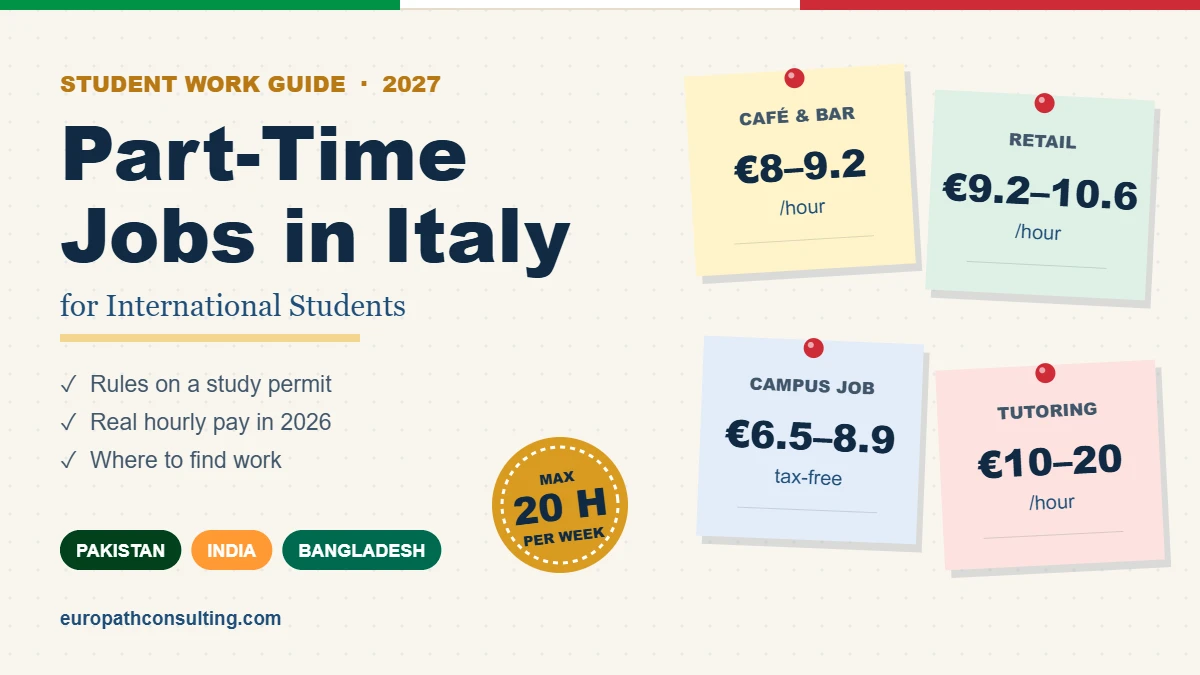
Can you work while studying in Italy? Yes, up to 20 hours a week.
Everything students from Pakistan, India and Bangladesh need to know about part-time jobs in Italy: the legal limits, real pay from Italian wage contracts, the best student jobs, where to find them and what changes after graduation.
The rules for working on a study permit: what’s allowed
The work limit comes from Article 14 of Presidential Decree 394/1999. Breaking it can cause problems when you renew your permit, so learn these rules before you sign anything.
Employee work up to 20 hours a week
A part-time employment contract (lavoro subordinato) of 20 hours a week or less, up to 1,040 hours a year. Campus “150-hour” jobs and internships are also fine.
Working more in the holidays
Many websites say you can “average” hours and work full-time in summer. Italy’s National Labour Inspectorate said in 2022 that no single week may go over 20 hours, even in holidays.
Self-employment, freelancing and partita IVA
The law only mentions employee work. Freelance work with a VAT number (partita IVA) is a grey area, so check with your local Questura before you open one. Delivery apps such as Glovo and Deliveroo use self-employed riders; Just Eat hires riders as employees.
Working while your permit is being issued
Since Law 179/2025, you can work temporarily while your permit is being issued, renewed or converted, as long as you have the post-office receipt (ricevuta). Keep a copy for your employer. The 20-hour limit still applies.
How much do part-time jobs in Italy pay? Real 2026 figures
Italy has no fixed national minimum wage. Pay is set by sector wage contracts (CCNL), and the 2026 “fair wage” decree (DL 62/2026) makes these contracts the legal minimum in each sector. These are the lowest entry levels most students are hired at:
| Job / contract | Gross per hour | Gross per month at 20 h/week | Notes |
|---|---|---|---|
| Bar, café, restaurant CCNL Pubblici Esercizi, from June 2026 | €8.08–9.19 | €695–790 | Levels 7 to 5; plus 13th and 14th month pay |
| Shop, supermarket, retail CCNL Commercio, 2025/26 | €9.16–10.61 | €770–891 | Levels 6 to 4; plus 13th and 14th month pay |
| University “150-hour” job Sapienza, Florence, Brescia calls | €6.50–8.90 | Paid per contract (e.g. €1,295 for 150 h at Sapienza) | Tax-free, on campus, flexible around classes |
| Occasional work (PrestO) INPS scheme | at least €9 | Varies | Up to €5,000 a year from all users; tax-free |
| Paid internship (tirocinio) Regional minimums, 2026 | – | €450–800 a month | Lazio €800, Piedmont €600, Lombardy €500, Veneto and Emilia-Romagna €450 |
Gross figures: about 9% goes to social security (INPS) and income tax is usually zero below €8,500 a year (see taxes). Informal jobs such as tutoring and babysitting are agreed privately and often pay €8–15 an hour.
Best part-time jobs for international students in Italy
Campus “150-hour” jobs
€6.50–8.90/h · tax-freeLibrary, front desk, labs and student services. Your university publishes a yearly call (bando collaborazioni 150 ore); students are ranked by merit and income.
Italian often needed (e.g. Sapienza asks for B2)Bars, cafés and restaurants
€8–9.2/hWaiting tables, kitchen help, dishwashing and pizzeria work. The easiest first job in big cities, with evening and weekend shifts that fit around classes.
Basic Italian helps; kitchen roles need lessRetail and supermarkets
€9.2–10.6/hShelf stacking, cashier and stock work. Large chains and international brands in Milan, Rome and Turin often hire students for weekends.
Customer-facing roles need ItalianWarehouse and logistics
€8–10/hPacking and sorting through temp agencies such as Adecco, Randstad, Gi Group and Manpower. Shifts can be early or late, so check they fit your timetable.
English-friendlyTutoring and teaching English
€10–20/h (private)Teaching English, maths or coding to Italian school pupils. Strong English is a real advantage here for students from Pakistan, India and Bangladesh.
English-friendlyHotels, tourism and events
€8–10/hReception, breakfast service and housekeeping in tourist cities. Many hotels value English, Urdu, Hindi or Bengali speakers.
English-friendly in big citiesFood delivery
Per delivery or hourlyJust Eat hires riders as employees. Glovo and Deliveroo use self-employed riders and have faced investigations into working conditions in 2026, so read contracts carefully.
English-friendlyInternships in your field
€450–800/monthThe best option from year 2 onwards. Paid internships build your CV and often lead to a job offer and a work permit after graduation.
English-friendly in tech and engineeringWhere to find part-time jobs in Italy
How to start working in Italy: 6 steps
- Get your codice fiscale (tax code). You usually receive it with your visa or at the Questura; you can’t be hired without it.
- Apply for your residence permit within 8 days of arrival and keep the post-office receipt. It lets you work while the permit is being issued.
- Open an Italian bank account with an IBAN, so your salary can be paid.
- Prepare an Italian-style CV (one page, photo, languages with levels, your availability around classes) and search on the sites above.
- Check the contract before signing: no more than 20 hours a week, the CCNL and level, hourly pay and contract length. Your employer must register the job with the authorities (Unilav).
- Register with the national health service. With a work contract, SSN registration becomes compulsory and free, so you no longer pay the €700 voluntary fee.
Taxes, payslips and refunds
- Income tax: employees pay effectively no income tax (IRPEF) up to about €8,500 a year, thanks to the employee tax credit. Above that, the first band is 23%.
- Social security: about 9% of your gross pay goes to INPS. It counts towards your Italian pension record.
- Refunds: your employer withholds tax each month. If you work only part of the year, you may have paid too much and can claim it back with the 730 tax return, often free through a CAF office.
- Campus 150-hour jobs and PrestO occasional work are tax-free.
Will working affect my DSU scholarship or permit renewal?
- DSU: part-time work is allowed with DSU. Your Italian earnings are counted in a later year’s ISEE, so a well-paid year can lower your future grant. Check your region’s DSU call before taking extra work. See our DSU scholarship guide and ISEE parificato documents.
- Permit renewal: you must again show at least €10,179.85 a year and enough exams passed. Legal, traceable income such as payslips and PrestO earnings can help you show this money, but cash payments can’t, so avoid working “in nero” (off the books).
After graduation: from student job to work permit
Convert your study permit to a work permit
Since 2023 (DL 20/2023), university students can convert at any time of year, outside the yearly quotas, once they have a job offer. In practice employers usually offer at least 6 months and 20 hours a week.
Job-seeker permit (attesa occupazione)
After an Italian bachelor’s, master’s or PhD, you can apply for a permit of up to 12 months to look for work, then convert it to a work permit when you are hired.
6 mistakes to avoid
- Working more than 20 hours in any week, including in summer.
- Accepting cash jobs without a contract. They don’t count as income and give you no protection.
- Opening a partita IVA (VAT number) without checking with the Questura.
- Counting on a job to pay for your first months. Bring savings for at least 3–4 months.
- Letting work hurt your exams. Failing the exam rule can block your permit renewal and DSU.
- Signing a contract without checking the hourly pay against the CCNL level.
Part-time jobs in Italy: FAQ
Can international students work in Italy while studying?
Yes. Students with an Italian study residence permit can work as employees for up to 20 hours a week and 1,040 hours a year. The 20-hour limit applies to every week, including holidays.
How much can a student earn from a part-time job in Italy?
Entry-level jobs in bars, restaurants and shops pay about €8–10.6 gross an hour under Italian wage contracts. At 20 hours a week that is roughly €700–890 gross a month (about PKR 2.2–2.7 lakh, ₹75,000–95,000 or BDT 97,000–1.2 lakh).
Can I work full-time in Italy during summer holidays as a student?
No. Italy’s National Labour Inspectorate has said a study-permit holder may not work more than 20 hours in any single week, even during holidays. To work more, you must first convert your permit.
Do I need to speak Italian to get a part-time job in Italy?
For most bar, shop and campus jobs, basic Italian helps a lot. English-friendly options include warehouse and logistics work, food delivery, hotels in big cities, English tutoring and internships in tech or engineering.
Can I work in Italy before I receive my residence permit card?
Since Law 179/2025, foreigners can work temporarily while their residence permit is being issued, as long as they have the post-office receipt. The 20-hour weekly limit still applies.
Do students pay tax on part-time jobs in Italy?
Employees pay effectively no income tax up to about €8,500 a year, and about 9% of pay goes to social security. Campus 150-hour jobs and PrestO occasional work are tax-free.
Can I stay in Italy and work after graduation?
Yes. You can convert your study permit to a work permit outside the yearly quotas once you have a job offer, or apply for a job-seeker permit of up to 12 months after an Italian degree.
Plan your studies and your budget with EuroPath
We help students from Pakistan, India and Bangladesh choose the right university and city, win DSU and arrive with a realistic budget, including part-time work.
Free profile evaluation💬 WhatsApp usCheck eligibilityKeep planning
Last checked: October 2026, against DPR 394/1999 art. 14, INL note of 24 May 2022, Law 179/2025, DL 62/2026, 2026 CCNL pay tables, INPS PrestO rules, university 150-hour calls (Sapienza, Florence, Brescia) and the MUR 2026/27 circular for international students. Rules can change, so confirm with your university and Questura.