
What does studying in Italy really cost in 2027?
Real 2026/27 figures from official university and government sources, with fees for Pakistani, Indian and Bangladeshi students, city-by-city living costs, a month-by-month cash plan and example budgets in PKR, INR and BDT.
Tuition fees at Italian public universities for PK, IN & BD students
Italian universities don’t charge international students one fixed price. Fees depend on the university, your family income (ISEE parificato) or your country. Bangladesh is on Italy’s 2026/27 list of “particularly poor countries” (Ministerial Decree 176/2026), so Bangladeshi students often pay the lowest rate or nothing at all.
| University | How fees work | Pakistan & India | Bangladesh | Extra taxes |
|---|---|---|---|---|
| Sapienza (Rome) | Flat fee by country band | €300 (Band A, latest published) | €300 (Band A) | Check call |
| Pavia | Flat rate by citizenship, or ISEE | €390 total (Bracket 1) | €390 total | Included |
| Turin (UniTo) | Flat fee by country GDP | €500 + €156 | Exempt pays €156 | €156 |
| Pisa | €2,900 × coefficient by World Bank income group | Likely €580 | Likely €580 | €140 + €16 |
| Politecnico di Torino | Scaled by country GDP (PPP) | €761 + €161 | Exempt pays €161 | €161 |
| Bologna | Fixed reduced fee by country list | From €1,000 (Bachelor’s) / €1,200 (Master’s)* | €500 / €600 | €157.04 |
| Padua | Fixed fee for families abroad | €2,790–2,990 | €930–997 | €192 + €16 |
| Politecnico di Milano | ISEE-based (income abroad) | €157–3,943 | €157–3,943 | Up to €190 + €16 |
| University of Milan | Country groups A/B/C | €200–4,101 by group | €200–4,101 by group | €146 |
| Trento | Merit-based (English-taught Master’s) | €0–6,000 | €0–6,000 | — |
Compare more universities: see all 17 public universities ranked by fee for Pakistan, India and Bangladesh in our guide to the cheapest universities in Italy.
Sources: official 2026/27 fee regulations of each university (Padua, PoliMi, UniMi, Sapienza, Turin, Pavia, Pisa, Trento) and the MUR decree. *Bologna band for Pakistan and India depends on the university’s country list. Fees can change each year, so confirm in your university’s regulation. Compare more on our universities page.
Monthly living costs by city
These are the universities’ own estimates for a student: rent in a shared or single room, food, transport and basics.
Sources: cost-of-living pages of PoliMi, Bologna, Padua, PoliTo, Pisa, Trento and Sapienza. Some totals are our sums of the university’s rent, food and transport figures; smaller-city range is our estimate.
One-time costs before and after you arrive
| Cost | Amount | Notes |
|---|---|---|
| University application fees | €0–60 each | Many universities are free to apply to. See the list |
| Study visa (Type D) | €50 | Paid in local currency (e.g. PKR 16,250 in Jul–Sep 2026; ₹5,350 in India), plus VFS service charge |
| CIMEA statement (if needed) | €150 | €250 urgent; €300 with verification. Some universities accept a DoV instead |
| Translations & legalisation | Varies | Attestation, apostille and translations of degree and ISEE documents |
| Residence permit (permesso di soggiorno) | €116.46 | €70.46 payment slip + €16 stamp + €30 post office fee |
| Health cover | €700 / year | Voluntary registration with Italy’s national health service, or a private policy accepted by your consulate |
| Flight | Varies | Cheapest when booked early; book after your visa is approved |
Sources: Consulate in Karachi, VFS Global India, CIMEA, University of Padua and Pisa residence-permit pages.
Proof of funds for the visa: €10,179.85 a year
For 2026/27, Italian embassies ask students to show at least €848.32 for each month of the academic year, which is €10,179.85 a year (about PKR 31.4 lakh, ₹10.8 lakh or BDT 14.1 lakh). The Embassy in Islamabad confirms this amount and does not accept cash, bank guarantees or surety bonds. A DSU scholarship letter can help cover it. Read the full rules in our Pakistan and India visa guides.
When you’ll need the money: your first-year cash plan
Knowing the yearly total is only half the picture. Most students get into trouble because they don’t know when each payment is due. Here is the order in which money leaves your account, for a typical student at a low-fee public university in an average city.
Getting admission
- University application fees: €0–60 per university at most public universities
- Degree attestation (HEC, MEA or Bangladesh Ministry of Education) and translations
- CIMEA statement of comparability, if your university asks for it
Visa and travel
- Visa fee €50 plus the VFS service charge
- Show €10,179.85 in your bank account. You don’t spend this money, but it must be there.
- One-way flight to Italy: about €450–700
The most expensive months
- Rent deposit (usually 1–2 months’ rent) plus the first rent payments
- Residence permit kit at the post office (about €120) and health cover (€700 a year for voluntary national health registration, or private insurance)
- Regional tax and first tuition instalment (about €160 with DSU)
- Food, transport pass, SIM card, bedding and kitchen basics
Monthly living
- €600–1,100 a month depending on city and room type
- DSU winners usually receive the first grant instalment in this period, and the remaining instalments later in the year
- Part-time work is allowed up to 20 hours a week
3 example budgets: what the first year can look like
These examples use the official 2026/27 fees and the living-cost figures above. They are illustrations, not real students.
Master’s at Sapienza, Rome, in a shared room
Rome’s tuition is among the lowest in Italy, so almost all of the budget is rent and living.
Master’s at Politecnico di Milano, Milan, highest fee band
This is the top end. Applying for DSU or a fee reduction based on ISEE can cut the tuition a lot.
Bachelor’s at University of Turin, shared room
The cost of living doesn’t change with DSU. The grant simply pays for a large part of it.
Exchange rates of 15–19 Oct 2026: €1 = PKR 308.88, ₹106.54, BDT 138.76. Want a budget for your own profile? Get a free profile evaluation.
Want to earn while you study? Read our guide to part-time jobs in Italy for international students: the 20-hour rule, real pay and where to find work.
7 ways to cut your costs
Skip test costs too: many universities accept an MOI letter instead of IELTS. See study in Italy without IELTS.
Keep planning
Cost of studying in Italy: FAQ
How much does it cost to study in Italy for Pakistani students?
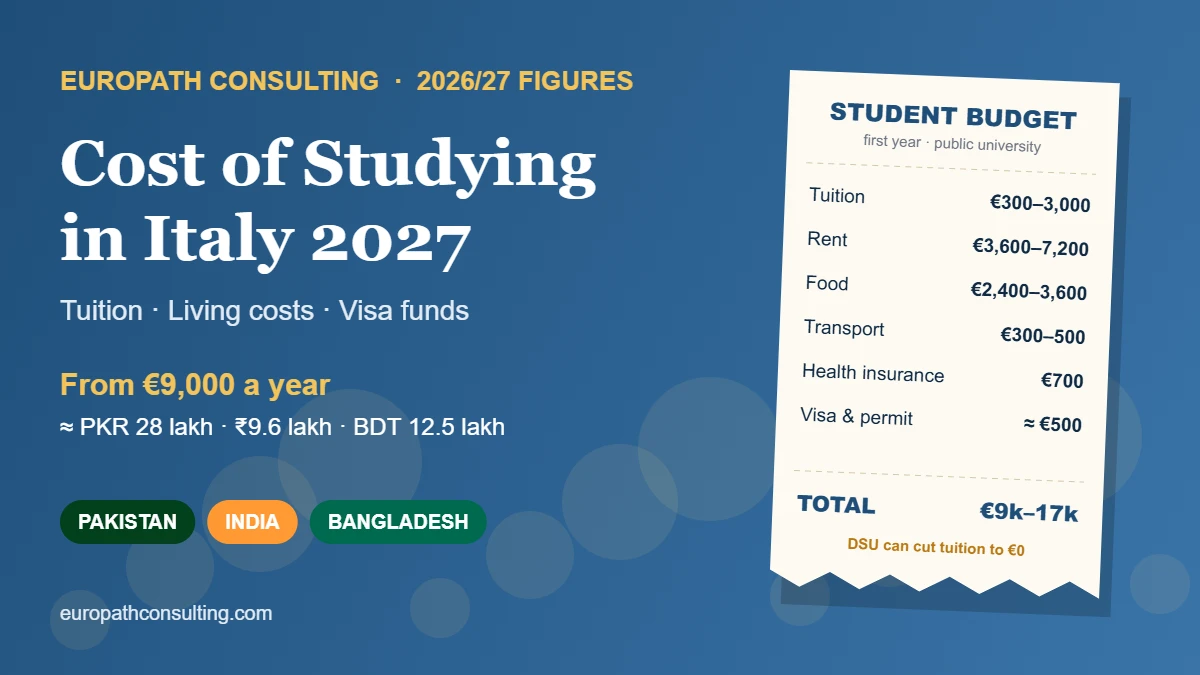
At public universities, Pakistani students usually pay about €300–3,000 a year in tuition (e.g. €300 at Sapienza, €390 at Pavia, €656 at Turin, €2,990 at Padua) plus €600–1,100 a month in living costs. A realistic first-year budget is about €9,000–17,000 (around PKR 28–53 lakh). DSU can waive tuition.
How much does it cost to study in Italy for Indian students?
Indian students generally pay the same rates as Pakistani students at most public universities: roughly €300–3,000 a year in tuition plus €600–1,100 a month to live. A first-year budget is about €9,000–17,000 (around ₹9.6–18 lakh).
Is studying in Italy cheaper for Bangladeshi students?
Often, yes. Bangladesh is on Italy’s 2026/27 list of particularly poor countries, so many universities exempt Bangladeshi students from tuition or charge reduced fees (e.g. Turin and Politecnico di Torino charge only about €156–161 in taxes, Padua about €930–997).
What is the living cost in Italy for students per month?
University estimates range from about €550–750 in smaller cities to €800–1,100 in Milan, Rome and Pisa, including rent, food and transport. Shared rooms and student canteens keep costs lower.
How much bank balance do I need for an Italy student visa?
For 2026/27, Italian embassies ask for €848.32 per month, or €10,179.85 per year, shown on your bank statement or covered by a scholarship such as DSU.
Can I study in Italy for free?
Effectively, yes, for many students. The DSU regional scholarship usually waives tuition and pays a yearly grant, and some universities exempt students from particularly poor countries such as Bangladesh.
Study in Italy on a budget that works
EuroPath Consulting helps students from Pakistan, India and Bangladesh choose affordable universities, win DSU and prepare a visa-ready budget.
Last checked: October 2026, against official 2026/27 university fee regulations, cost-of-living pages, Italian embassy and CIMEA sources. Fees and exchange rates change, so confirm with your university before budgeting.