

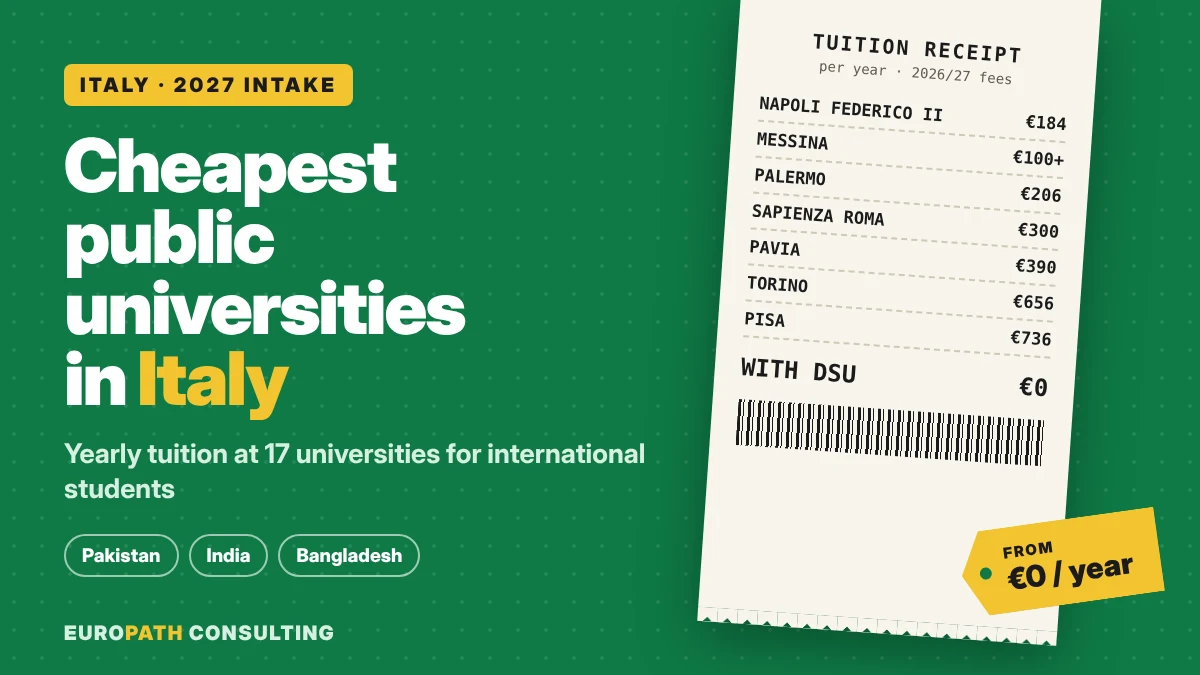
We compared the cheapest universities in Italy for international students, using the fees each university published for 2026/27. Pick your country below and the list re-sorts by what you would actually pay.
Tuition fees by university, cheapest first
Fees below are per year for students whose family lives and earns abroad, as published for 2026/27. Tap any university to see how its fee is calculated.
University of Naples Federico II
How the fee is calculated
The 2026/27 student guide says non-EU students are fully exempt from the enrolment contribution; you pay the regional tax (€167.50 without an ISEE) and €16 stamp duty. Official source
University of Messina
How the fee is calculated
2026/27 annex: Group A (least developed, e.g. Bangladesh) €0, Group B (lower-middle income, e.g. India, Pakistan) €100. Regional tax and stamp duty are extra. Official source
University of Palermo
How the fee is calculated
€206, €256 or €356 depending on your country’s list, including the €156 regional tax. The page does not state the year, so confirm when you apply. An ISEE parificato route also exists. Official source
Sapienza University of Rome
How the fee is calculated
Pakistan, India and Bangladesh are in Band A: €300 in three instalments. The page does not say whether the regional tax is added. Official source
University of Pavia
How the fee is calculated
2026/27 Fees’ Regulation: Pakistan, India and Bangladesh are in Bracket 1, €390 in four instalments for all subject areas. Official source
University of Turin (UniTo)
How the fee is calculated
2026/27: €500 for countries with GDP per capita (PPP) up to €26,000, plus the €156 first instalment. Countries on the ‘particularly poor’ list (including Bangladesh) pay only €156. Request the reduction by 20 November 2026. Official source
University of Pisa
How the fee is calculated
2026/27: lower-middle-income countries pay €580, plus €140 regional tax and €16 stamp duty. The World Bank currently classes Pakistan, India and Bangladesh as lower-middle income; the university’s table decides. Official source
University of Perugia
How the fee is calculated
2026/27 flat bands for income and assets abroad: €400, €600, €800 or €1,000 plus €16 stamp duty, depending on your country’s band. Official source
Politecnico di Torino
How the fee is calculated
€761 plus €161 in taxes for Pakistan and India; students from exempt (particularly poor) countries pay only €161. Official source
University of Verona
How the fee is calculated
Non-EU citizens living abroad with a foreign qualification may apply for a €1,000 all-inclusive annual fee. Official source
University of Rome Tor Vergata
How the fee is calculated
€1,000 for most courses, or €500 for countries on the MUR developing-countries list (Bangladesh), plus €156 regional tax and stamp. Medicine, Pharmacy and some economics master’s are €2,500 + €156. Official source
University of Bologna
How the fee is calculated
Reduced fixed fee from €1,000 (bachelor’s) or €1,200 (master’s), or from €500 / €600 for particularly poor countries, plus the €157.04 fixed instalment. Official source
Ca’ Foscari University of Venice
How the fee is calculated
2026/27: €1,300 all-inclusive for most non-EU countries, or €700 if your country is on the low human development list (check the university’s PDF). Includes €192 regional tax and €16 stamp. Official source
University of Milano-Bicocca
How the fee is calculated
2026/27: Group 1 €200–300, Group 2 €900–1,100, Group 3 €2,990–3,600 by subject area, plus €146 first instalment and up to €60 regional tax balance. Check Appendix 4 for your country’s group. Official source
University of Milan (La Statale)
How the fee is calculated
€200 to €4,101 depending on your country group, plus €146. Official source
Politecnico di Milano
How the fee is calculated
Fee is calculated from your family’s income and assets abroad; low-income families pay close to the minimum. Official source
University of Padua
How the fee is calculated
2026/27 all-inclusive: €2,790 (humanities) or €2,990 (sciences); particularly poor countries €930 or €996.66. Padua also offers full fee waivers for international students. Official source
Fixed fees are sorted by their total; ranges and “+ taxes” entries are sorted by an estimated typical total (midpoint of the range, or the fee plus about €156 in regional tax and stamp duty). The budget filter uses the same estimate. Courses such as Medicine can carry a separate fee. Fees can change each year, so always confirm in the university’s call before you apply.
Why international students pay so little
Italian public universities do not charge a separate “international” price. Fees depend on family income, and because your family’s income is abroad, most universities apply a fixed fee by country instead.
Fixed fee by country
Used by Sapienza, Pavia, Turin, Pisa, Padua and most universities in this list. Lower for countries on the Ministry’s ‘particularly poor’ list, which for 2026/27 includes Bangladesh and Nepal but not Pakistan or India.
ISEE parificato
Your family’s income and assets are converted into an Italian ISEE by a CAF. Politecnico di Milano and some others use it to set your fee. See our ISEE parificato documents guide.
DSU scholarship: €0
DSU winners are usually exempt from tuition and pay only the regional tax and stamp duty. Compare limits and deadlines in our DSU by region guide.
Mistakes that make Italy cost more
- Choosing a university only by fee. A €300 fee in an expensive city can cost more overall than a €1,000 fee in a cheaper one.
- Missing the fee-reduction request deadline (Turin: 20 November 2026). Late requests pay more or lose the reduction.
- Applying without a DSU scholarship plan. The DSU waives tuition and pays living costs, so prepare your ISEE parificato documents early.
- Assuming English-taught Medicine costs the same as other courses: check the course’s own fee.
Applying for a master’s? See MS in Italy for Pakistani students and our Master’s in Data Science in Italy guide for programmes at these universities.
Cheapest universities in Italy: common questions
Which is the cheapest public university in Italy for international students?
Based on fees published for 2026/27, the lowest are the University of Naples Federico II (non-EU students pay about €184 in taxes because the contribution is waived), the University of Messina (€0 to €100 plus taxes) and Palermo (€206 to €356). Sapienza (€300) and Pavia (€390) are the cheapest well-known northern and central options.
How much is university tuition in Italy for Pakistani students?
At public universities, Pakistani students with a family abroad usually pay between about €184 and €3,000 a year, depending on the university. Many popular universities charge under €1,000: Sapienza €300, Pavia €390, Turin €656, Pisa €736 and Verona €1,000.
Do Bangladeshi students pay lower fees in Italy?
Often, yes. Bangladesh is on the Ministry’s 2026/27 list of particularly poor countries, so universities such as Turin, Politecnico di Torino, Padua and Tor Vergata apply a lower fee. Pakistan and India are not on that list.
Can I study in Italy for free?
Yes, effectively. Students who win a DSU regional scholarship are usually exempt from tuition and pay only the regional tax and stamp duty, on top of receiving up to about €7,000–8,000 a year for living costs.
Are these fees per year or for the whole degree?
Per academic year. Bachelor’s degrees last 3 years and master’s degrees 2 years, so multiply by the length of your course. Universities can update fees each year.
Do I need an ISEE parificato to get these fees?
Not for the fixed country-based fees listed here: they apply to students whose family lives and earns abroad. Some universities, such as Politecnico di Milano, calculate your fee from an ISEE parificato instead, and you also need one to apply for the DSU scholarship.
Want the cheapest university that fits your profile?
Tell us your degree, grades and budget. We shortlist low-fee public universities where you qualify, check your fee band, and plan your DSU scholarship for 2027/28.
Sources (checked 30 October 2026): each university’s official fee page, linked under “How the fee is calculated”; MUR Ministerial Decree 176 of 24 February 2026 (particularly poor countries 2026/27). Fees are per year and may change; the university’s current call always prevails.